Types of Assessments
WISC-V The WISC-V measures intellectual ability of children from 6 to 16 years.

Cognitive Assessments
WISC-V
The WISC-V measures intellectual ability of children from 6 to 16 years. It was developed to provide an overall measure of general cognitive ability, and also measures of intellectual functioning in Verbal Comprehension (VC), Perceptual Reasoning (PR), Fluid Reasoning (FI), Working Memory (WM) and Processing Speed (PS).
2 hour appointment, best conducted in morning.
WIAT-III
The Wechsler Individual Achievement Test (WIAT) is a standardized academic achievement test for people aged 4 to 50 years, 11 months used to measure previously learned knowledge in the areas of Reading, Written Language, Mathematics, and Oral Language. The WIAT is suitable for use in a variety of clinical, educational, and research settings, including schools, clinics, and private practices to identify the academic strengths and weaknesses of a student, to inform decisions regarding eligibility for educational services, educational placement, or diagnosis of a specific learning disability and to design instructional objectives and plan interventions.
2 hour appointment, best conducted in morning.
WAIS-IV
The Wechsler Adult Intelligence Scale is a comprehensive cognitive assessment tool designed specifically for individuals aged 16 years and older. It has been used for over 70 years to assess an individual’s cognitive ability and intelligence. The WAIS-IV assessment consists of a series of subtests that measure various aspects of cognitive functioning, including Verbal Comprehension (VC), Perceptual Reasoning (PR), Fluid Reasoning (FI), Working Memory (WM) and Processing Speed (PS).
2 hour appointment, best conducted in morning.
UNIT-2
The UNIT-2 is designed to provide a fair assessment of intelligence for individuals aged 5 to 21 years, 11 months who have speech, language, or hearing impairments; have different cultural or language backgrounds; or are verbally uncommunicative . The manual describes studies of the UNIT2 being used with Black/African American, Asian American/Pacific Islander and White examinees; Hispanic and non-Hispanic examinees; Native American and White examinees; English as a Second Language (ESL) and non-ESL examinees; and deaf and hard-of-hearing and non-deaf/hard-of-hearing examinees. Diagnostic information is provided that is relevant to common educational exceptionalities, including intellectual disabilities, giftedness, and learning disabilities.
2 hour appointment, best conducted in morning.
MIGDAS-2
The Monteiro Interview Guidelines for Diagnosing the Autism Spectrum, Second Edition is a sensory-based process for gathering and organizing the qualitative information needed to diagnose autism in children, adolescents, and adults. The process includes guidelines for gathering information from parents/caregivers and teachers, and for conducting a sensory-based interview with the individual being evaluated. The end result is a comprehensive behavioural profile that describes the individual’s distinct way of relating to the world, supplementing assessment scores and informing diagnosis and treatment planning. The MIGDAS-2 process is designed to facilitate writing a narrative evaluation report and providing diagnostic feedback using language that is easily understood by parents and others involved in the individual’s care.
1.5 hour appointment, best conducted in morning.

Questionnaires & Screeners
Conners 4
The Conners 4 is designed to assess ADHD and its most common co-morbid problems in children and adolescents aged 6 to 18 years old. When used in combination with other information, results from the Conners can provide valuable information to guide assessment decisions. The Conners 4 has parent, teacher, and self-report forms, thereby capturing multiple perspectives.
Cost: $16.50
Provider: MHS
Conners EC
The Conners Early Childhood (Conners EC) assesses behavioural, emotional, and social concerns, as well as developmental milestones in preschool-aged children (2-6 years). It is a multi-informant assessment of young children across multiple settings, with forms for parents and teachers/childcare providers.
Cost: $16.50
Provider: MHS
CBRS
The Conners CBRS is a comprehensive instrument which assesses a wide range of behavioural, emotional, social, and academic concerns and disorders in children and adolescents aged 6 to 18 years. It is a multi-informant assessment of youth across multiple settings, with rating forms for parents, teachers, and self.
Cost: $16.50
Provider: MHS
ASRS
The ASRS is used to quantify observations of children and adolescents aged 2 to 18 years that are associated with Autism Spectrum Disorder (ASD). When used in combination with other information, results from the ASRS can help determine the likelihood that a youth has symptoms associated with ASD.
Cost: $16.50
Provider: MHS
CAARS-2
The CAARS-2 is an assessment that prompts individuals to provide valuable information about themselves and is helpful when considering a diagnosis of ADHD in adults aged 18 + years. The CAARS quantitatively measures ADHD symptoms across clinically significant domains while examining the manifestations of ADHD in adults based on scientific literature and the authors' clinical experience.
Cost: $25
Provider: MHS
Creating a cost proposal
How to create a cost proposal:
- Clinicians will create a Teams Task under Operations →Assessments→Assessment Tasks→Cognitive Assessments or Screenings & Questionnaires
- The task will list out each assessment/screener/questionnaire/report writing hours requested for the client
- Open the desktop version of the Assessment Cost Proposal spreadsheet to begin calculating the cost of the assessment
- At the top of the document, ensure you are using the correct fees (NDIS, Provisional, General, or Clinical)
- Input the relevant information into the Spreadsheet to calculate the total cost/confirm the quote
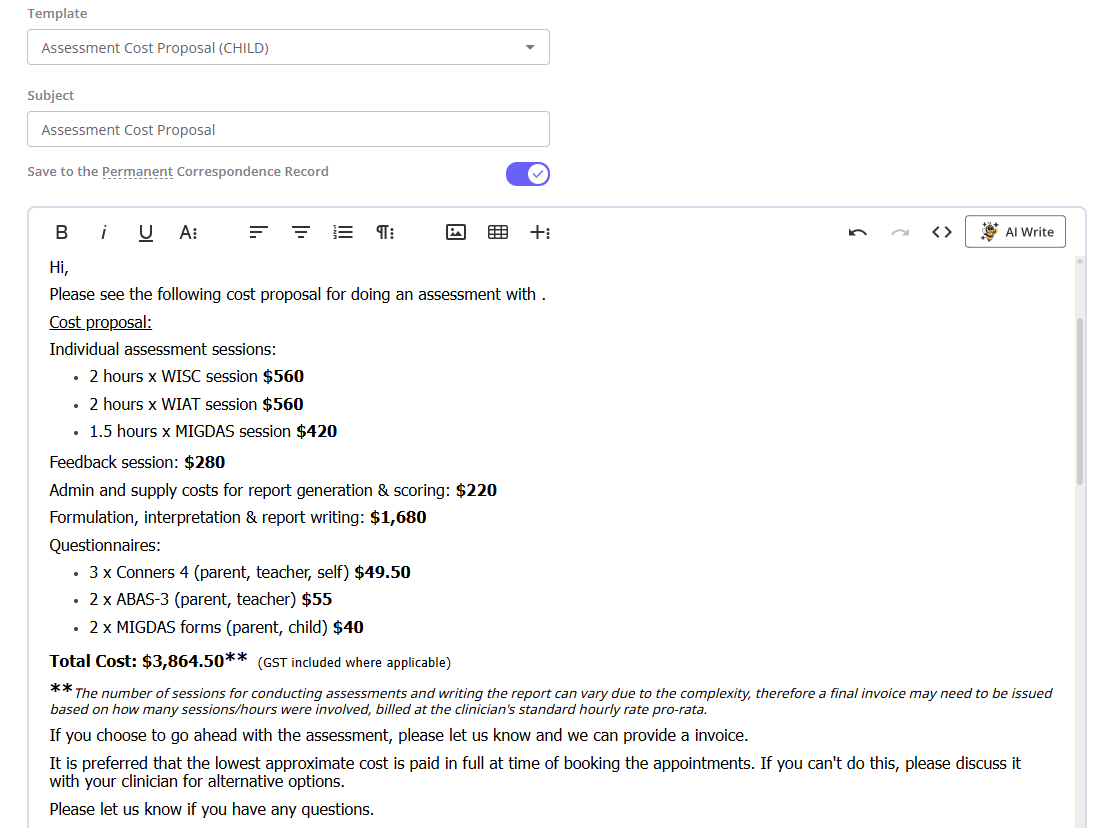
- Once confirmed, open the Client Profile in Zanda and go to Communication → New Email.
- Based on the assessment, select either:
- Assessment & Questionnaire Proposal → for assessments using only questionnaires/screeners
- Assessment Cost Proposal (CHILD) → for child assessments using cognitive/neurodevelopmental assessments
- Assessment Cost Proposal (ADULT) → for adult assessments using cognitive/neurodevelopmental assessments
- Input the details of the assessment.
- Click Save and Send.
- In the Teams Task, comment 'Cost proposal sent'.